Showing posts with label buoys. Show all posts

Friday, August 11, 2017

Review: Custom Carter DSMB Float

Introduction

I wanted an auto-inflate DSMB Float (see here for more info) as a security device in case I got a cramp and needed help getting back to the surface. I also thought it could come in handy if I need to pull a big fish out of under a rock or even to mark a spot so that I can go rest a bit at the surface but still find it later.

While researching DSMB floats I came upon this post, it got me thinking that I needed a setup like his because I have a tendency to get cramps at times and this could happen to me too.

I finally narrowed my choice down to:
They both had good reviews but I settled for the Carter Float for the following reasons:
  1. It is quality hand made by James Carter; who makes heavy-duty lift bags to bring sunk boats up, for example.
  2. It has a 25 lbs (~11 kg) lift (using a 38 gram CO2 cylinder)
  3. He could custom make one for me with 2 CO2 inflators
They both have:
  1. On way oral/manual inflation valve (useful if you are out of CO2 and have to use the float as a emergency flotation/signalling device)
  2. Safety relief valve to vent out excess gas to prevent unsafe internal pressure

General Impressions

I take it with me each time I go spearfishing, it fits snugly on my weight belt on my back and does not bother me at all. It is very well made, the material is tough and of quality; it will not puncture easily and having the safety relief valve will keep it from popping when you go up (due to the change in water pressure).

Here is a picture of the inflated float standard float with one CO2 cylinder; it is not my picture because I didn't want to inflate it on land:
The reason I wanted two CO2 inflators on mine is that since I travel mostly by plane to spearfish I am not able to fly with a CO2 cylinder (due to airline safety regulations) . Since finding a 38 gram cylinder is not easy, I decided to use two 16 gram cylinders instead; these can be purchased in any store that sells bicycle supplies/most sports stores.

Here is what my float looks like:


Since I wanted to put it on my weight belt I needed a holder for it, I got the Riffe Utility Float Holder which works great:


I will add some pictures of my full setup next time I use it.

Safety Device

I suggest trying it out in situations where you may need it so that you understand how it works and its limits.

I have tried inflating it twice, once in a mock emergency situation with my dive buddy and once alone.  In the mock emergency situation with my dive buddy (both of us with our weight belts) it wasn't much help, there was just too much weight. Alone it worked much better and if I had dropped my weight belt (I must unclip the Carter float first) it would have been even better. I tried it as an emergency flotation device and it works well, I recommend dropping your weight belt if needed though. I have not tried flagging a boat with it (for the obvious reasons).

Underwater Marker

I have not tried it as an underwater marker yet, I wanted to be able to partially inflate it with a CO2 cylinder so I devised a setup using the float's oral inflation valve, an adapter (that I still need to work on) and a micro CO2 bicycle tyre inflator with a control value:


I will update this part once I finish it and try it out.

Catch Lifter

I have not yet needed/tried to use it for this, I will update this when I do. 


Conclusion

I am very happy with it, I think it is an important piece of equipment to have with you; I feel safer with it on me. I would recommend getting something like this if you can. If this is too pricey for you you can try buying a simple Surface Marker Buoy (SMB, aka Safety Sausage) and rigging it with an adapter and an on/off bicycle CO2 value, but I wouldn't risk it personally.

Monday, March 23, 2015

Review: Pocket Bouy

Introduction

I was looking for a portable Buoy with a high flag that I could fly with (so it also needs to be light). I found the Pocket Buoy and found the concept alluring:


It has a foldable flag and inflates using regular party balloons, everything is neatly stored in a mesh plastic bag that can be used to put a counter weight:


Flag & Pole

The flag pole is like a small tent pole (fiberglass tubes with an elastic running through the middle, this is a great idea and allows it to fold up nicely as you can see in the above picture. The version I had purchased was their first and there were some defects which I worked around (more on this later):

  • The flag pole dismantled when used in windy conditions/choppy waters: I added a string that spanned the length of the pole and titghtened it when in use, this kept the tubes from coming apart.
  • The plastic part where the flag pole attached to the buoy cracked on the inside after some use and the pole fell out: I removed the inside of the flag attachement part and used epoxy to fix the pole back on, this held great.

The flag is a nice nylon flag, not one of those cheap plastic flags like Best Hunter uses. I feel it is big enough and that the flag pole is high enough:


The Buoy

The buoy is a nylon sphere with two quarter circle plastic parts inside that come together in the center with a pin. The form a foldable half circle for structure; the ends of each quarter circle have a threaded part to where you can attach the flag pole and on the other side the counter weight pole:


On the center of the nylon sphere is a small slot so you can slip in the uninflated balloon and inflate it, once inflated just tie a knot and you are done. It comes with a couple balloons and you can buy more from them. The balloons are 17" (43cm) outdoor balloons (thicker than the party type), I ended up having to get new balloons quickly so I got regular indoor ones and doubled them up (I had no local source for the outdoor type or the possibility/time to order them), it works just fine and it is cheap. Smaller balloons may work but I wouldn't try as they wouldn't fill up the nylon sphere. I have never had the balloon(s) puncture and I have used the same balloon for two days (on the 2nd day I had a backup with me just in case). After the 2nd day of heat and salt does make the rubber feel a bit weaker so I wouldn't push it. They also sell a more heavy duty inflatable ball that you can use instead of balloons. I read it does not fully fill up the nylon sphere, it makes it a bit more heavy in your luggage and you have to have a pump (which for me defeats the purpose of the original design), but some people may want that:


The counterweight

To attach the counterweight you have a single flag pole segment that attaches like the flag pole, it has a metal plug and a hole so you can attach something to it. You can either directly attach a lead weight as shown in one of the above pictures, buy their a counterweight pouch (also shown being used in an above picture):


but I just use the storage mesh pouch:


and pick up a heavy stone and stick it in the pouch. The original counterweight pole attach point had the same issues as the flag pole.

Support & Build

I ran out of balloons while on a trip and I wasn't sure of the balloon size so I emailed the maker. I got a quick reply and as I thanked them I told them I liked their product and that I had had only some small issues since I worked around them). They told me that the Pocket Buoy has a lifetime warranty and that the first batch had some issues and that they had fixed them, so they sent me (to my home) replacement parts. They had fixed the flag pole coming apart issue like I had done it (but more professionally) and had reinforced the flag and counterweight pole attach points. I have not had any issues with these new parts. I have since used the old flag pole to replace Best Hunter Okipa II flag pole with a new flag (see here for more info).

Conclusion

I am very happy with this buoy, it does what I need in a neat way. I am using the buoy only to signal my presence and not to help me fight/land fish (I have a post about buoy/floats in general here); for this later use case I would not use it. I had some issues with the version I purchased, it was their first version and I worked around the issues myself but as mentioned above the product has a lifetime warranty and they replaced the faulty parts quickly with no hassle. I applaud their great customor service, thank you. Since then I have never had any issues. I would recommend this product for a similar use case as mine. 

Wednesday, February 25, 2015

Review: Best Hunter Okipa II Float

Introduction 

I do mostly reef/shore/rock spearfishing, max 100m from the shore and usually no more than 30m deep; I advance along the shoreline. I therefore don't have a boat hanging around and I needed some way of carrying my extra spearguns, water, some energy bars, my phone, ID, keys, etc. I also need a buoy and dive flag (which I already had). For these reasons I decided to start looking for floats that could meet my needs. I found essentially three types that could do this:
  • The boogie board type
  • The mini-boat type (my name for them)
  • The flat type (like an inflatable boogie board or a flattened torpedo)
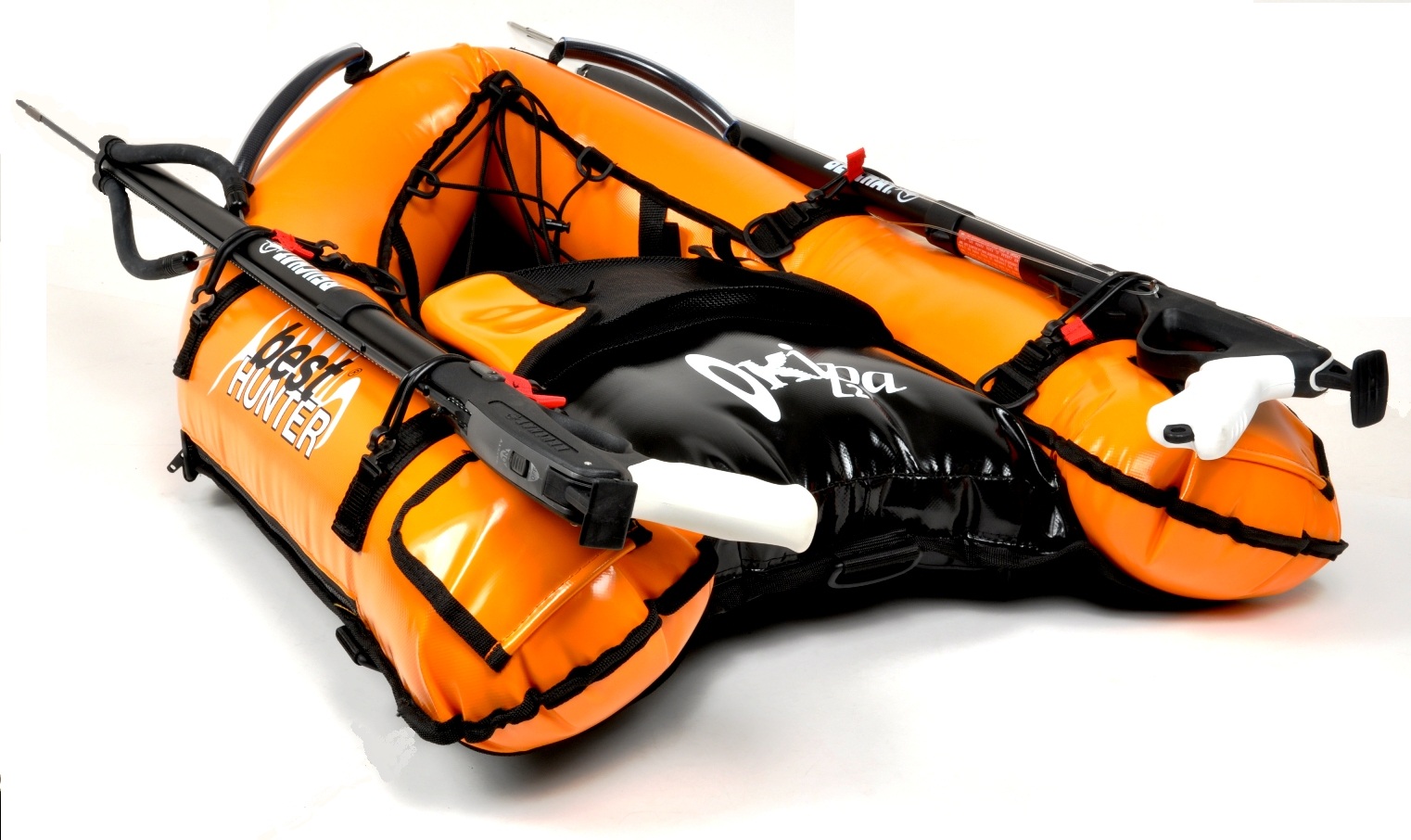
Since I travel often by air to go spearfishing that leaves me with the later two, see my post for more info on buoys. I decide on the mini boat type because I could carry more things, I could rest on them if needed and they don't flip over easily like the flat buoys. After reviewing several I decided upon Best Hunter's Okipa II float:

Specifications

  • Thick Outer PVC & Nylon fiber shell, UV, salt and tear resistant
  • Three inner removable inflatable bladders
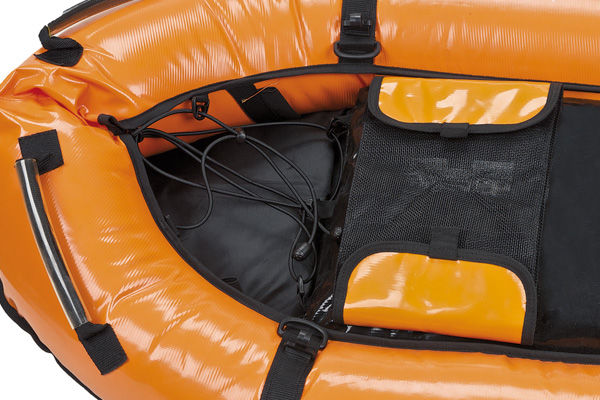
  • Elastic net in the front
  • Two speargun attachments on the top sides
  • Many attache points on the top and bottom
  • Two handles in the front
  • Central mesh pocket
  • Diver down flag and pole
  • Includes a small foot pump
  • Dimensions (L x W x H): 90cm x 62cm x 16cm
  • Weight: 1.85kg
  • Colors: orange & black

Build 

The build quality is impressive, I didn't realize how well it was made until I had it in my hands. The thick outer layer is very tear resistant, I have lugged it around on sharp rocks and it still has no damage other than some superficial scratch marks. Having the removable inner bladders means that in the event that you do puncture one the float will not sink (I could see how it could flip over if it is heavily loaded and the punctured bladder is on the side) and it means you can replace a damaged or worn bladder without replacing the whole float:

The bladder material is a type of thick plastic a bit like inflatable toys but much ticker. The values are the non-return type and once in the outer shell they are accessible via a heavy duty Velcro flap:

Pockets, attach points, etc 

The central mesh pocket is about (I need to measure it) 26cm x 20cm x 5-7cm (L x W x H), I can fit two pairs of flip flops/water shoes and some other small things; it has an opening on each side that closes using thick Velcro:

It also has a front "hole" that is covered with an elastic net, this is where I put water a water tight bag with other things (you can see it in the picture above also):


The four speargun attachments use a silicon ring to secure the spearguns:


they are made to hold four small spearguns or two long ones, I have put two long and two short on them if you don't mind the spearguns touching; it makes taking one speargun a bit more difficult though. Here is a picture with two long spearguns:


It has other attach points in the back (one), in the front (one, excluding the handles), on each side (two at the outer bottom and two in the inner top), around the elastic net and one on the bottom (towards the front). I use the front attach point to tie my towing line and small anchor, the bottom side attach points to attach spearguns I am using when in a stationary good fishing spot (they just hang down). The center or back attache point to put the fish bag (although if the water is too hot I attach it above the anchor). On the other anchorage points I have attached dive bags before if we are several and we have a lot of stuff. The dive flag is a bit flimsy, it kept on sliding down the pole so I suggest to get a new one. I got a good one from Dan's FreeDiveStore:

and used a makeshift folding pole (lsmall tent pole segments); I no longer have any issues with it. The Okipa includes a small foot pump that is not so good, I quickly got a new more powerful one.

Usage 

It does exactly what I want, it has not flipped over yet even in choppy water (although the waves did pull everything out of the front pit, bu I had tied everything down on the anchorage points). It is a bit heavy to swim around with since it has much more drag than a simple buoy, especially when it is full, but I had expected that and the benefits outweigh this. I usually inflate it before leaving the house and carry it on my back using the handles, I can even put my long spearguns on it when I do that. I decided to get a small (500g) grapnel anchor:


which I tie on the end of my drag line, if I find a nice spot I can "setup camp", quite convenient. One thing you do have to be careful of when around the float, especially with rougher waves, is that if you have spearguns attached on the top they can spear you, it happened to a friend (nothing major this time), so always make sure you have the tips covered (I use old speargun rubbers that I cut or wine corks) and be careful. With it's orange color and dive flag, I feel quite safe that I can be seen, this helps especially in areas where you have lots of boats. If you are tired you can use it to swim like a boogie board by using the handles:

He didn't inflate it very well
and you can even sit on it (not that I have tried):
This is not the Okipa but you get the idea
And if you have too many fish, it can carry them for you ;-)

This is previous version in black, no longer made

Conclusion 

Albeit being a bit more expensive than other floats and heavier (1.85kg, for those who need to fly), I think this float is excellent and does everything I need. I have had the opportunity to try a flat inflatable buoy and I am happy I did not get one; yes it is smaller & lighter but it flipped over on calm water as soon as we put something on it that had a bit more weight on one side, also it wasn't able to hold much stuff. It does have some minor issues that I mentioned but this is far from a show stopper, I recommend this product for any spearfisherman that has similar needs as I have.

Update:

I recently took it out a couple of times and it tore at the seam in one spot:


To be fair, I think I inflated it too much and with the heat it expanded more than it should have, thus the tear. I am still very happy with it and I will try to repair it somehow. If anyone has any ideas please don't hesitate to share :-).

Tuesday, April 15, 2014

Spearfishing safety

Introduction

In this post I will speak of spearfishing safety. I will mention safety guidelines towards others and for yourself.

Safety Issues

First and foremost, you should never spearfish alone, you need to find a dive buddy with whom you feel safe, both of you need to know what to do in the event of a problem. The types of problems you can encounter are (in no particular order, there are others):
  • Shallow Water Blackout (SWB): this is were your body no longer has enough oxygen, you blackout usually swimming back up to the surface or even after you have reached the surface and breathed fresh air. This is IMO the most dangerous thing that can happen because it gives no warning at all, your body doesn't react to not having enough oxygen but instead reacts to having too much carbon dioxide (this is what triggers the urge to breath) and you never realize you don' t have enough.
  • Getting tangled in some sort of net, line, etc: this is another way to drown, it can easily be avoided though if you carry a knife or scissors.
  • Getting stuck in an underwater cave: this can be avoided also by simply not going into caves, if a big fish swam inside then too bad, you weren't fast enough and it won, get over it.
  • Strong underwater current: this is harder to avoid since you cannot see it before swimming into it. If you get caught in one try to swim up quickly and beware of rocks.
  • Sharks: these are a problem in certain parts of the world (mostly tropical and sub-tropical).
  • Getting bashed on rocks: this can usually be avoided by not going in rough water, it is a bit trickier when you get swept up by a strong current.
  • Boats: in most places you have the obligation to have a buoy with a dive flag, this warns boats you are in the water, the boats should stay more than 50m from a buoy. This is the nice and dandy theory, unfortunately some boat captains either don't see the buoy or don't care. If you encounter those then if you can take a picture of their identification number and report them to the authorities. I am not saying this to be mean, but this is dangerous for you and they will remember to look (and respect the distance) when confronted by the authorities, I know, it sounds lame, but this is your and other spearfishermens' lives in danger and as a captain they are required to respect this, just like a car driver has to look out for motorcycles, bicycles and pedestrians.
  • Your dive buddy: this may surprise you (or not), but many accidents involve your buddy shooting you. As a general rule you should never point your speargun towards a human being, you should always have the safety one until the last possible moment (before you shoot, this is easier with some spearguns than others, see my speargun post's section on different speargun brands' safety mechanisms) and you should never have a loaded gun outside of the water (this is often by law). It is also recommended that you hunt with one gun and take turns, when one is below the other observes him/her. This has the added safety that you rest and get your oxygen levels up again (to help prevent SWB) and you can react if your buddy gets in trouble. Some people hunt one in from of the other with a big distance in between each other, others hunt in parallel also with lots of distance. When the water is murky it becomes more difficult. You should use the same safety rules as you would when using a firearm.
  • Hypothermia: this is a problem mostly in cold waters and when you don't wear the correct wetsuit. In reality it can happen even in tropical waters if you stay long enough, the water is colder than your body temperature and has higher thermal conductivity than air so it will literally suck the heat out of you. Most of the time you can be safe by not going in in cold water without the proper equipment and by not staying longer than you should.
  • Cramps: this can be a problem if you are under water. There is no sure way to prevent this or know it is coming, you can only eat potassium and magnesium regularly to help guard from it but that is all. I read of a person who had this happen to his legs and he used his DSMB to get back to the surface.

Safety equipment & guidelines

There are some guidelines and equipment you can have to make spearfishing safer (by problem):

General

  • Quick release weight belt: this is a good idea to have, most weight belts are like this. It means that if you have an issue and you have to swim up as fast as possible, you can quickly drop your weight belt. For this reason I would not up anything expensive on the weight belt, some people put their dive knife on it but they could hesitate to drop the belt because if that. YOUR LIFE COMES FIRST, your dead body has no use for a dive knife. Here are examples of a SCUBA type belt (left) and a spearfishing (Marseillaise) belt (right):

Shallow Water Blackout (SWB)

  • Freedivers Recovery Vest (FRV): this is an inflatable life vest that is triggered by either going too deep, staying too long under or not confirming you are conscious after reaching the surface. It is a bit pricey but worth it, especially if you are a bad boy and dive alone. It will bring you back to the surface and flip you on your back, see here for more info, have a look at these pictures:
  • Dive computer: a dive watch with depth alarms, dive time alarms and surface recovery alarms; these are different from SCUBA dive computers. Some SCUBA dive computers that are wrist watches have some of these functions, like the Suunto D4i. Other dive computers are specifically made for freediving, like the Aeris F10v2, Aeris F11, Beuchat Mundial 2, Mares Nemo Apneist, Sporasub SP1 Freediving, Sporasub SP2 Freediving and Cressi Edy II. The alarms allow you to understand where you are in regards to know your depth (how long it will take you to swim back up), time under (an idea of how much oxygen you have left), surface recovery time (how long you have to wait until your next dive to be fully oxygenated).

Sharks

  • Using a buoy with a stringer: this keeps your catch away from you, the best is to have two buoys, one for the catch and one for yourself. If you have you catch in the water, they will go after it, this is why YOU SHOULD NEVER CARRY YOUR CATCH ON YOU. If you can, always keep your catch out of the water in places that have lots of sharks.
  • Stay calm, if you are agitated and move in a distressed manner they will be attracted to you. They are curious animals so just because you see one doesn't mean they want to eat you; most of the time they scope you out and leave.
  • I don't recommend trying to stab, shoot or spike the shark unless it is of last resort, sharks are curious animals and will swim close to you to check you out. If they come too close, you can prod them with the metal tip but not stab them, stabbing or shooting them will only make them mad. Usually the contact with something metallic will make them less curious.
  • Having a metal spike attached to the gun's muzzle can help you detour them, some spearguns have this by default. This is useful because if the spear is not on the speargun and a shark shows up you have the spike to help keep the shark away. I would use a line setup that allows you to keep the gun once you have shot a fish, either with a reel (and lots of line) or a breakaway setup. A good example of a shark safe gun is the Speardiver Carbon Elite Speargun (no longer available):
    Shark spikes can cause other issues though, they are dangerous. For example if you shot a powerful fish and you are handling it via the shooting line and it darts off, the line will slide through your hands and the speargun could stab you in the back, legs or even head. A safer solution would be a retractable shark spike, see here for a discussion concerning this.
  • You can have powerheads for last resort if you get a shark that does not get the point, these are essentially aluminium cylinder that fire on the point of your speargun and have a bullet at the end. The spear point acts like the firing pin and will detonate on impact with the shark. There are reusable types and one use types. The one use types are supposed to be less prone to misfiring since the bullet is fully encased/watertight (they are anyways a last resort safety feature, a bit like an airbag in a car). Reusable types allow you to use them several times as the name implies but you should use a new bullet each new hunting session to be sure your bullet will work when needed. Here is a good example of one-use powerheads (Speardiver Quick Slip-on Powerhead) with a convenient pouch (Speardiver Powerhead Belt Pouch):
     
    and also Neptonic's new newly designed reusable K.O. Powerhead with has a dual safety design: 

  • Having a knife: don't get excited, this will almost never be of any use, sharks are too fast and you are safer further away from them, but push comes to shove...as a last resort.
  • Boat/shore: yep, get out of the water but do not turn your back to the shark.

Boats

  • Buoy, flag & floatline: this can be attached to yourself or to your speargun. If you attach it to yourself be careful about becoming tangled/attached to something. If you attach it to your speargun it helps you from losing it in case you shoot a big fish but you could become separated from the buoy in this case, both have pros and cons. either way the boats can see you are around and steer clear. See here for more info.

Tangled

  • Knife or scissors: in case you get caught up in something you can cut your way out. See the info about the quick release weight belt above and look here for more info about knives.

Hypothermia

  • Wetsuit: an adapted wetsuit will guard against this, you will still be limited on how long you can stay in the water depending on the quality of the suit, its fit, the thickness, the density of the neoprene, the type/cut, dry/semi-dry/wet, etc. Beware of overheating however! See here for more info on wetsuits.
  • Boat/shore: get out of the water, if your wetsuit is lined you will lose more heat with the wind so either wear a wind breaker, get out of the wetsuit and into cloths or go inside.

Cramps

  • Delayed Surface Marker Buoy (DSMB): aka CO2 inflatable safety sausage, this can be useful to go back to the surface in case you have a cramp or if you have to bring your buddy up fast. See here for more info. Here is an example:
  • Freedivers Recovery Vest: (see Shallow Water Blackout above), it has a manual inflation latch:

I hope this information is helpful to someone, please correct me (add a comment) if you see something wrong and add comments or extra info.

Saturday, January 25, 2014

Floats/Buoys

Introduction

Floats are an essential part of spearfishing, there are different types and different uses. I will use the words Buoy and Float interchangeably throughout this post. Below I will talk about the main types in no particular order.

Base/normal Buoy (with or without flag)


These are used to mark your location in the water, so that boats know you are there and to stay clear of this area. Some have flags and some don't. In many places it is a legal requirement to have this type of float and to have a certain type of flag. They are inflated orally or by using a pump, before going in the water. They can either be anchored and the spearfisherman hunts around it, moving it when he/she changes spots, or it can be attached to the spreargun's handle or to a breakaway system (see my speargun article); in this case it it toted around all the time and serves as an additional safety to ensure a fish does not swim off with your speargun.

Flags

There are two types of flags:
  • North American "Diver down flag": This flag is red with a white stripe from the upper left corner to the lower right corner.
  • International "Diver down flag" (aka "Alpha Dive Flag"): This flag represents the code signal A International maritime signal, it is white and blue.

Shapes

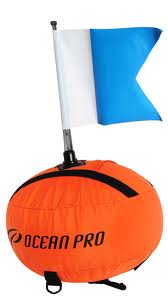
There are many different types/shapes to choose from. The classic shapes are the spherical:
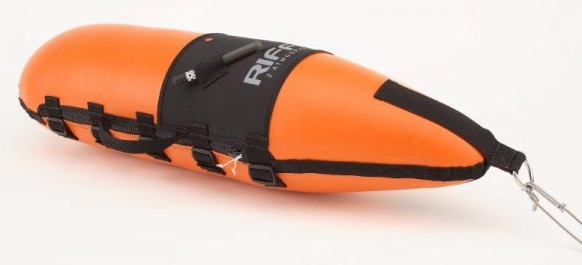
which is good for staying in one area, it fairs well to choppy seas and usually has a high flag which allows you to be seen from farther away. Then there is the torpedo:

Which is better for towing around due to its streamlined shape, the flag is usually not high fine they can flip over easily which is why I don't like these with flags (they are fin without). Since you need a flag in many parts this is why I don't use this shape. A variant of this is the bullet:
These excel in kelp forests, they don't get tangled up as much due to their shape.

Then you have the boogie board type:
Banks board, the best in its class
A homemade one, the most affordable
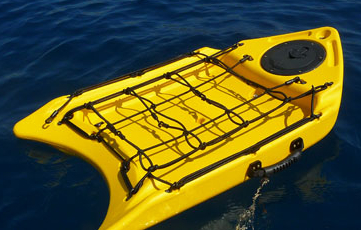
These allow you to carry more stuff with you and even carry your catch out of the water if you are in shark territory. The don't flip over so easily but have more drag in the water. I would use this if you need to carry things around with you (water, 1st aid kit, phone, car keys, food, etc). These are not inflatable so it rules out air travel.

The next type is the flat inflatable type:
Unfortunately Best Hunter no longer makes this one
These are relatively light and relatively streamlined but still allow you to carry some gear such as spearguns, some water, your phone. The upper one is wide enough so that it does not flip over easily but the second one, the most common size, flips over quite often so I would use it to carry only a phone and car keys plus a speargun or two (they are often on the bottom on this type).

Next we have the boat type:
This is a cross between the flat inflatable and the boogie board types. It is inflatable and allows you to carry quite a lot of stuff with you and does not flip over easily. Being inflatable it is airplane friendly. Like the boogie board type it has a lot of drag, more than a boogie board, that is the price to pay.

Surface Marker Buoy (SMB, aka Safety Sausages)

This type of buoy is a long skinny cylinder. It is used by spearfisherman to mark the diver's location generally when he/she is out of the water. It is a good thing to have with you in case you have to signal boats by waving it around. It is also used to mark a location underwater, for example a small cave entrance/big rock where you spotted a big fish inside/under or to mark the location of a shot fish in kelp forests. For this last use-case it is not needed to fully inflate it, but please be aware that there are dangers of using precious O₂ underwater to inflate a buoy, you could black out easier when returning due to the lack of oxygen. These are inflated orally while in the water on a single need basis and is attached somewhere in case it is used to mark underwater locations. One variant is the Delayed Surface Marker Buoy (DSMB). It has a CO₂ inflation mechanism to allow inflation underwater without sacrificing your lung's air supplies. It can therefore be used to bring you or other small items up quickly (provided you have the correct amount of CO₂) or to help pull fish out of under rocks/caves/kelp. Some good DSMBs are the Carter Float, the Riffe Utility Float and the Ultimate Utility Float.

Blue Water Floats


I'm not sure of the name, but you get the idea, these are used when targeting big fish in the water and are usually torpedo/suppository shaped. They are either rigid (usually foam filled or pre-inflated) or inflatable via a pressure pump/compressor. They are usually labeled by pressure using atmospheres (atm) as the unit, common types are 2atm and 3atm. They are attached to the speargun or mostly on breakaway systems so that when you spear a powerful fish it has to fight against the float.

Attaching floats

You usually attach floats using either a braided floating line or a tubed float line. if Blue water hunting you can add a bungee line in between the float and the floatline. As the name explains, a floatline floats :-); the reason for buoyancy is that when you dive the line stays vertical and doesn' t snag on everything.
  • Braided floatlines: they are cheap and they do the job. They are braided nylon usually and are not as buoyant as tubed floatlines though and thus can snag on stuff more. On the positive side they are light and not bulky thus won't weigh down and take up space in luggage.
  • Tubes floatlines: this is a spectra (or nylon for the cheap ones) line that runs in a soft watertight tube. They are quite expensive because of the materials used and the more complex manufacturing involved. They float well but are bulky and heavy.
You can either attach them to
  • a speargun handle:
  • a breakaway system:
  • a small (500g-750g) grapnel anchor:

My Buoys

As you know I have to travel often by plane to spearfish so I have to take this into consideration when buying buoys. I don't want to have to carry a pump or have to go find one somewhere (I know service stations have them but I don't want to have to find one). I chose to buy:
  • Pocket Buoy: this float folds up small and is really great especially when traveling light, it even has a lifetime warranty. It uses balloons to inflate, the bigger type (43cm/17"), which are relatively easy to find and light to carry; for the counter weight you can put rocks in the bag and clip use that. I am very happy with it, I initially got the first version that had design flaws (the flag pole came apart with waves but it since got fixed and they sent me replacements for free.
  • Carter Spearfishing Float: I wanted a DSMB so that I could signal my location in case I get carried away by current, also I want to mark interesting spots (with fish!) under water and in emergency cases get pulled up to the surface fast. I purchased the dual inflator model and also the Riffe Utility Float Holder so that I can put it on my weight belt. To mark the spot under water, I hook up a bike CO₂ inflator regulator to the oral inflation valve and partially inflate it, keeping the two CO₂ inflators for emergencies or to pull up stubborn fish stuck in holes.
  • Best Hunter Okipa 2: I love this float! It is a bit pricey, heavy and cumbersome, even when deflated, but it is so nice to have. It is like a little boat or an inflatable buggy board, you can put two spearguns on it, water, food, etc, and use it to rest. It is still airline friendly and provides you with a base buoy including the flag. It is a bit bulky to lug around in the water, so I tend to use it anchored, sort of like "base camp" and use the pocket buoy if I want to travel a bit further (not too far to keep an eye on it though). Click here to read my review.

If yo have any remarks or if I made any mistakes, please don't hesitate to comment below!