Thursday, January 8, 2026

Review: LingHunt PoleSpear

Introduction

I was looking into getting a PoleSpear, I wanted a new challenge and I have never used one so I thought I would try. I was also looking for a "lite" Spearfishing solution, an alternative to my JBL Travel Magnum Combo SpearGun, one I can just pack and take off with when for example travelling with the family on a "beach" vacation. This allows me to pack light and not have to bring all my gear, that way if I have time and find a spot I can hunt for a couple of hours and if not then I didn't waste precious luggage space/weight. This means that I need a PoleSpear that breaks down into smaller sections so that I can travel with them.  I had a look at what was available and decided to go for aluminum instead of composites (fiber glass/carbon fiber) mainly because I hunt in reefs/rocky bottoms and I think composites are more fragile in these environments. I also have a personal preference for metal as it showcases the craftsmanship & engineering better. I shortlisted two makers that fit what I was looking for: Both makers have Aluminum breakdown PoleSpears and had good reviews, I ultimately ended up choosing LingHunt because I believe their PoleSpears:
  • are of better quality and engineering from various discussions I have had with owners of both
  • are made in a small family owned shop that privileges quality craftsmanship and engineering
  • offers a more personalized experience (if this is what you like, you can also just order something from their site if you dont like this)
  • has different breakdown sizes (18ft/~46cm & 24ft/~70cm); you could request other sizes if you want
  • the owner is a very knowledgeable and great guy
 

What are PoleSpears exactly?

PoleSpears are a kind of long spear that uses a rubber attached to the back end for propulsion and have a spear tip on the other. It resembles hand harpoons used by various tribes (ancient and contemporary) and is a very simple but elegant design. In some parts of the world is one of the only legal ways to spearfish (the other being Hawaiian slings). PoleSpears are defined by their length (usually 3ft-10ft/~91cm-304cm), thickness (usually 0.5in-0.75in/~1.27cm-1.9cm) and the material they are made of (usually Aluminum, Fiberglass, Carbon Fiber); some makers include the tip as part of the length and others (such as LingHunt) do not. Generally, the longer the PoleSpear the farther you can shoot it but of course this also means there is more of a chance of it bending. To counterbalance this bending issue you can:

  • for metallic SpoleSpears, augment the thickness but this also makes it heavier, thus it is in the end a balancing act between length and thickness
  • use composites instead of metal

I will mostly describe aluminum SpoleSpears since this is what I researched the most and ended up buying.

PoleSpears are also either able to breakdown or not, being able to breakdown has the following pros/cons:

  • Pro: it is easier to travel with
  • Pro: it allows you to have many PoleSpears in one, just mix and match the tubing to get the length that you need
  • Pro: easier to fix, since the tubing is shorter you can also always just replace the broken tube
  • Con: it also makes the PoleSpear heavier (due to the joints/connectors, usually made of SS)
  • Con/Pro: more fragile (for the aluminum types), since it can potentially break at the joints/connectors, but at the same time the tubing being shorter it is less likely to bend as much as a single long tube
  • Con: the joints/connectors could become undone in the water

As mentioned above, thicker tubing will flex less but it is heavier and this will of course affect the distance it will fly. On the other hand, a thicker & heavier tube will give more punch when it hits the target due to the added inertia, thus blue water PoleSpears are usually thicker (and longer). As I mentioned, I prefer aluminum for the hunting terrains I go to because composites are more likely to be damaged, so this would mean that composites are better for blue water hunting but since they are much lighter than metallic ones they have less punch (but fly farther) and bigger pelagic fish have tougher skin and bones than coastal fish; I would be interested in having feedback from a blue water hunter that prefers composites to understand the reasons.

Tips/Points

PoleSpear tips are much longer than SpearGun tips, other than that they are similar (see here for more info on tips/points). There are three main categories:

  • Flopper tips (a.k.a Tahatian tips)
  • Breakaway tips (a.k.a Slip tips)
  • Paralyzer tips

Flopper tips are the general purpose tips, they can either be arranged as:

  • Single flopper
  • Symmetric Dual Flopper
  • Asymmetric Dual Flopper

The tips can either be replaceable or not.

Breakaway tips are better for bigger fish and are a bit more fragile because their point is usually razor sharp and designed to penetrate tough skin and bones and not to hit rocks.

Paralyzer are quite popular with PoleSpears, they are a bit like tridents user on SpearGuns but usually longer and closer together (which reduces the drag). The idea behind these tips is in the name, when it hits the fish they become paralyzed (due to the impact force and the nerve overload). Most paralyzer tips do not have barbs but some do and the tips themselves can be replaceable or not.

For the archaeology aficionados, breakaway and paralyzer tip designs pre-date metallurgy, they were made out of wood, bone, flint and string.

Rubber/Band

The rubber is much longer than a SpearGun's and not as thick. You can/should twist it around the pole when you draw, this will make it spin when released and offers better hydrodynamics (just like a bullet is spun in the barrel of a gun) and will fly straighter. If you have a PoleSpear that breaks down then you need different rubber lengths depending on the length of the PoleSpear you setup. This can either be done by:
  • literally having different rubbers of different lengths (and switch them out as needed)
  • tying a knot in the rubber to shorten it temporarily
  • adding a "separation" segment to give you two or more "steps", allowing you to vary the force applied, this is actually a great idea from LingHunt

Some makers have roller mechanisms too, like BillFish Republic
or roller conversion kits, like Neritic.
Roller mechanisms on PoleSpears hasn't really caught on as it is more complicated to make/maintain and does not offer the benefits that roller SpearGuns or Compound bows have.

Resting hook

This one is a bit controversial and not common. This is a sort of hook that is attached to the band/rubber which allows you to "cock" the spear and hook it somewhere to rest your hand. It is more common in Japan for example but can be found elsewhere. The reason it is controversial is that in jurisdictions that ban SpearGun this could be seen as a trigger mechanism and thus make the setup illegal. Also there is a safety concern, there is no safety mechanism in this case but the spear is mechanically managed in a way. As you may know from reading my post on SpearGuns: I am against SpearGuns not having safety mechanisms; if the mechanism is released you could shoot yourself or someone accidentally. To be transparent, I had one put in my setup, although it is more to try-out than to use regularly (for the above reasons).

Section joints/connectors

The section joints are extremely important, they are what is going to keep your PoleSpear from coming apart. Your run-of-the-mill makers have simple thread mechanisms; these can become undone with vibrations, natural lubrication by the water and fish spinning around. You can counter this with thread seal tape (a.k.a Teflon tape) or a theadlocker like Loctite® 248, as described in my spearguns post but this is merely delaying the issue. Some makers have more sophisticated mechanisms, like this one [pic] or this one from LingHunt [pic]. The o-ring makes sure you have a tight fit with no water motion to lubricate the threads and cause them to slide. It also dampens vibrations a bit to the same effect. LingHunt's design does a step further, the end is not threaded to facilitate putting it together (quickly), reduce damage to the treads while keeping the whole joint tight and strong.

Another common issue with the threads, especially for smaller ones, is that the thread breaks. This actually happened to me on a water-proof watch crown, once the threads break your connector comes apart and needs to be replaced. One way of getting around this is to have a bigger pitch (the space between threads) making them thicker and thus stronger another way is to use cold formed threads (a.k.a rolled threads) instead of cut threads; the 1st technique being cheaper than the second. Most makers either use smaller pitch sizes and too bad if it breaks or bigger pitch sizes to make the threads stronger (and faster/easier to close). Only one maker, to my knowledge, uses cold formed threads and this is LingHunt. This allows them to have threads with a smaller pitch which are stronger than cut threads with the same pitch. Why is a smaller pitch important? Why not just go the cheaper/simpler route? The reason for this is that a smaller pitch has more surface area which allows you to have greater tension and a closer adjustment accuracy, both points translating to an overall tighter grip.

Water leaking into the tubing, if the tubes are hollow, can be beneficial or not (depending on your point of view). If the tube is fully waterlogged this will make it heavier, which will mean an impact has more inertia but it also means it will slow down faster and needs a thicker band (making is more difficult to use). It will also change the buoyancy which will affect how it glides through the water. Having a partially waterlogged PoleSpear is the worst thing ever, the water sloshing around inside will completely change the dynamics and it will just suck. Usually however, the point is to not have water inside thus watertight or solid PoleSpears are better; you need to make sure the PoleSpear does not float however! In the end it is a balancing act (Pole weight, buoyancy, inertia) that needs to be just right for you.

I found lots of interesting information about threads here if you are interested.

My PoleSpear

The PoleSpear I got is the LingHunt 5000 series (Deep Knurl and Finger Ring Grip), 5/8" thick with 18” sections, a flopper tip, a paralyzer tip and a breakaway tip. It is made of aluminum with their signature connectors  & grips and it is completely hand made. I have to say that it is beautiful, I almost didn’t use it and I just wanted to hang it on the wall! The craftsmanship and engineering that was put into it is incredible, you just feel the love that went into designing & making it.

Specifications

  • Tube section length: 18"
  • Tube diameter: 5/8"
  • Tube Material: Aluminum
  • Overall weight (including the three tips/points in the protective case (shortened poster tube) but excluding rubber): 1.4kg
  • Assembled Length without tip: 185cm
  • Assembled Length with tip: 230 cm
  • Rubber length (unfolder): ~100cm
  • Rubber diameter: 12.5mm

Order Process

LingHunt is a small family owned and operated shop, they offer a webpage with tons of information and an online shop where you can just click and order if this is your thing. If you have specific needs/requests then you can go down the more personal route, up to a fully bespoke setup if you want; I went down this path for my order. The owner and I had spoken a couple of years back and he is a very knowledgeable man and a great engineer. Myself also having studied engineering (different field though) I thoroughly enjoyed our conversations and learned a lot of interesting stuff! 

Once I had all the specifics of my order down, he sent me a list with prices for my setup and a payment link, I paid, they made the PoleSpear and sent it in time for my upcoming trip. Even if you go down the standard online shop/fast checkout path, keep in mind that they have to make your order. This means it will take some time, depending on their order backlog, so don’t wait for the last minute! If you tell them you need it for a certain date, the will to their best ability, move stuff around to get it to you, but don’t count on this because it may not be possible (so time your order accordingly). I thoroughly enjoyed my order process and as you probably know I like speaking to people about their product and feel their passion.

The Tubes (sections)

The tubes are made of aerospace quality aluminum and are light but sturdy, they are hollow but watertight. The aluminum is iodized with a black dye (not painted) which gives it a beautiful and quality finish. The back section is closed off with a plug that allows you to attach the rubber:


All sections except the front one have vertical groves cut into the tubes to create grips to prevent slippage when assembling and using the PoleSpear:


The front section has their signature deep knurl and finger ring grip which are sturdy, practical, and not prone to where like standard twist grips are. I always use glove but I can see how the knurl may (or may not) be uncomfortable without gloves depending on how soft your skin is. Here is a pic:


Connectors/Joints

The connectors are really beautifully engineered and well thought of……


Tips/Points

As described above, I purchased three tips:

·         a flopper tip: 


·         a paralyzer tip: 


·         a breakaway tip (aka slip tip): 


As you can see, the tips are expertly made, I did have an issue once with the breakaway tip where it did not engage correctly, what happened is the little cylinder got stuck on the “wing” of the part that breaks away (i.e. the point). Unfortunately I did not get enough hits with this tip to know if this is a common issue or not. Fortunately I did not lose my catch because I was able to rush in quick enough. I don’ t think this is a design issue per se, I have had for example floppers not deploy in the past (and floppers are simpler mechanisms); I just need more testing before I can say for sure. The nice thing about LingHunt is that they take your feedback with pleasure and use it to make their designs better if needed, or if you are doing something wrong then they take their time to help you.

One thing I would maybe change/upgrade would be to have replaceable tips on the points themselves (paralyzer tip and flopper tip). The reason for this is that I often hit rocks and although so far all is good, I know that even hardened SS does not withstand this abuse forever; I have to change my SpearGun points regularly when they become dull (I have no way to sharpen them and I think it is not trivial to sharpen hardened SS without altering its properties). I think just changing out the end part of the tip would be easier to do and cost less to buy and ship (and LingHunt makes them).

Resting hook

I know resting hooks are controversial because …… I wanted to have on with my order so I could try one out, it can be removed anyway if I really don’t use it. LingHunt only makes them on special request and is not keen on them being used (rightly so!). It is true that if you don’t use the PoleSpear often (at least for me it was the first time using one) you can get hand fatigue if you “cock” it in advance, but as you may know my stance on SpearGun safety I just didn’t feel comfortable using it without some sort of safety. The resting hook is sturdy and I have no doubts it will hold and not break/slip, but I just don’t feel right with it engaged. I am glad I ordered it and got to try it, no regrets, I don’t think this is something I will use often however.

Using it

It flies! It is nicely balanced in the water and solid. LingHunt send me some tips on how to best use it and they were greatly appreciated. It takes some getting used to however if you come from SpearGuns, especially holding the rubber for a long time. I had to adapt my hunting methods a bit and I still need lots of practice I think. I was afraid (when I decided to order a PoleSpear) that it would maybe flex a lot but it did not, it was nice and sturdy. I never once had doubts the joints/connectors would not hold (which is not the case for example with my JBL Travel Magnum Combo SpearGun shafts, but different concept I guess) and the tubes held tight and let no water in. You do have to be more careful using a PoleSpear than you do with a SpearGun when hunting in refs and rocky terrain however. This is because if you bend your Pole then you have to have it straightened out again and it will ruin your trip (as opposed to s SpearGun shaft which can be quickly replaced (I always have a spare with me) and even purchased locally depending on where your trip is. Depending on the type of SpearGun you have you can straighten it yourself worst case scenario, I am not sure I would attempt it with a PoleSpear.

Conclusion

I am very happy with my LingHunt PoleSpear, I had no issues with the pole itself, just one issue once with the slip tip as described above but it can happen. It is really a great product, great quality, it glides through the water straight and will last a long time if I take good care of it. I got the challenge I was looking for, I cannot say I am a very good PoleSpear user at the moment so keep this in mind if you are a beginner: you will need lots of practice and you have to get close and personal with the fish; it is a lot harder than using a SpearGun if you are in a place with nervous fish. I can highly recommend LingHunt’s PoleSpears and I believe everything they make gets the same love so don’t hesitate!

Friday, August 11, 2017

Review: Custom Carter DSMB Float

Introduction

I wanted an auto-inflate DSMB Float (see here for more info) as a security device in case I got a cramp and needed help getting back to the surface. I also thought it could come in handy if I need to pull a big fish out of under a rock or even to mark a spot so that I can go rest a bit at the surface but still find it later.

While researching DSMB floats I came upon this post, it got me thinking that I needed a setup like his because I have a tendency to get cramps at times and this could happen to me too.

I finally narrowed my choice down to:
They both had good reviews but I settled for the Carter Float for the following reasons:
  1. It is quality hand made by James Carter; who makes heavy-duty lift bags to bring sunk boats up, for example.
  2. It has a 25 lbs (~11 kg) lift (using a 38 gram CO2 cylinder)
  3. He could custom make one for me with 2 CO2 inflators
They both have:
  1. On way oral/manual inflation valve (useful if you are out of CO2 and have to use the float as a emergency flotation/signalling device)
  2. Safety relief valve to vent out excess gas to prevent unsafe internal pressure

General Impressions

I take it with me each time I go spearfishing, it fits snugly on my weight belt on my back and does not bother me at all. It is very well made, the material is tough and of quality; it will not puncture easily and having the safety relief valve will keep it from popping when you go up (due to the change in water pressure).

Here is a picture of the inflated float standard float with one CO2 cylinder; it is not my picture because I didn't want to inflate it on land:
The reason I wanted two CO2 inflators on mine is that since I travel mostly by plane to spearfish I am not able to fly with a CO2 cylinder (due to airline safety regulations) . Since finding a 38 gram cylinder is not easy, I decided to use two 16 gram cylinders instead; these can be purchased in any store that sells bicycle supplies/most sports stores.

Here is what my float looks like:


Since I wanted to put it on my weight belt I needed a holder for it, I got the Riffe Utility Float Holder which works great:


I will add some pictures of my full setup next time I use it.

Safety Device

I suggest trying it out in situations where you may need it so that you understand how it works and its limits.

I have tried inflating it twice, once in a mock emergency situation with my dive buddy and once alone.  In the mock emergency situation with my dive buddy (both of us with our weight belts) it wasn't much help, there was just too much weight. Alone it worked much better and if I had dropped my weight belt (I must unclip the Carter float first) it would have been even better. I tried it as an emergency flotation device and it works well, I recommend dropping your weight belt if needed though. I have not tried flagging a boat with it (for the obvious reasons).

Underwater Marker

I have not tried it as an underwater marker yet, I wanted to be able to partially inflate it with a CO2 cylinder so I devised a setup using the float's oral inflation valve, an adapter (that I still need to work on) and a micro CO2 bicycle tyre inflator with a control value:


I will update this part once I finish it and try it out.

Catch Lifter

I have not yet needed/tried to use it for this, I will update this when I do. 


Conclusion

I am very happy with it, I think it is an important piece of equipment to have with you; I feel safer with it on me. I would recommend getting something like this if you can. If this is too pricey for you you can try buying a simple Surface Marker Buoy (SMB, aka Safety Sausage) and rigging it with an adapter and an on/off bicycle CO2 value, but I wouldn't risk it personally.

Sunday, June 18, 2017

Review: SporTube Series 2

Introduction

I used to travel with my gear in regular luggage (and I still do occasionally), but at some point I wanted something dedicated that allowed me to travel with regular spearguns and spearfishing fins, so I decided to look at what was out there (see my Traveling with you gear post) and settled on the SporTube Series 2.


Specifications


  • Adjustable height between 122cm to 212cm
  • Width: 28cm, depth: 15.2cm, Weight: 5.45kg (without handle & lock)
  • Linear size (for airlines) between 165.2cm and 255.2cm, but I have never had an airline ask my to measure it or pay extra (other than the normal extra baggage fee). Mine is usually closer to the lower number.
  • Hard resistant plastic shell
  • Wheels for airport maneuverability
  • Lifetime warranty
  • Lockable

Build

The build is rock solid, I have no worries of my stuff getting damaged inside (as long as it cannot move around too much). I always take the spears out of the mechanism so it doesn't break (the mechanism). The wheels are also very though, I don't see them betting broken anytime soon.

Usage

I am able to fit the following (while keeping it close to the minimal length):

  • 4 spearguns
  • 3 knives
  • a 500g anchor
  • a big pump (for my Best Hunter Okipa II float), something like this.
  • a custom Carter float with it's belt attachment
  • a marseillaise belt
  • a 50m braided float line with its winder
  • 2 pairs of neoprene socks and gloves
  • a pair of fiberglass fins
  • 2 snorkels
  • other small misc. stuff

It is easy to use, tough; I do have some small issues:

  • The wheels are not very pronounced, so if the ground is not paved/flat then I usually have to carry it. That is one of the reason the wheels are to tough though. It also probably means that if you are shorter then you have to raise your arms a bit to make it roll, if not then it will just scrape the floor.
  • Since it travels as special luggage (like baby push-chairs/strollers), then it also has a tendency to be forgotten when there are connections, but this will happen with any special luggage.

Conclusion

I am very happy with mine and the size. As long as you can keep it on the shorter side airline should not bother you (at least not in Europe). If you get the series 3 it is much bigger and can fit much more, however it also looks more imposing and may be viewed as too big to be checked in as extra luggage by some airlines. Most airlines set 158cm as the max linear size so even the series 2 is technically too big but if you keep it short then I have never had issues with it. I think the smallest linear size you could get setup/have with on a series 3 is 180cm... Worst case they charge you are oversized/sports luggage.

Wednesday, June 14, 2017

Review: Breier 760B 'SG' fiberglass fins

Introduction

As mentioned in my fins post, I used to use "longer" snorkeling fins; they were cheaper, indestructible and fit in my luggage (along with my JBL Travel Magnum Combo Speargun & Pocket Bouy). At some point though, I decided to get "real" spearfishing fins and I settled for Breier 760B 'SG' fiberglass fins. It also coincides with my getting my SporTube series 2 which allowed me to travel with them during longer trips with friends.

About Breier

Breier is a small French company specializing in fiberglass and carbon fins. They make the blades themselves so they are not just re-branding like some manufacturers do. They also custom make footpockets and blades if you have special needs. They have various footpockets to choose from, not sure if you can ask them to use models they don have (I assume you can if you send them to them, maybe you can order them and ship to them directly, but you should ask first).

My footpockets

I outfitted mine with Seac Sub Motus footpockets (which they were kind enough to mail me so I could try one one first for the size; I paid for the S&H) which fit my foot type (thin). I also wanted them not to glue the footpockets to the blades and and with the Seac Sub they don do that.

I also wanted to add patterns to them (they have several to choose from in different colors); this is a paying option. I choose a lighter color on the bottom so it is easier to see me from the top, orange is still visible if you are not too deep (I don't go deeper than 20m) but you should get yellow if this is a worry for you. The red is because it disappears rather quickly and it just looks cool. Here is a picture of my fins:


Here are some pictures of the footpockets:


Why Fiberglass?

Some of you may wonder why I got fiberglass and not carbon fiber or polycarbonate? I have polycarbonate fins already, even thought they are not true spearfishing fins, and I wanted something that would allow me to progress and that is lighter. Carbon fiber is not good for the type of spearfishing I do, it is too fragile. I believe it is good for blue water but for shore, rock and reef spearfishing it is going to be damaged too quickly and I don't see where it would be better in those conditions. Be aware of how you kick off the bottom, if you push with your toes too much you can break your fins. I usually do a flat footed jump movement to get off the ground and then rotate and swill up.

Performance

I find that longer fins do help a lot with spearfishing performance-wise. I cannot really objectively say if fiberglass performs much better than same length polycarbonate fins, but I am quite happy with them. Keep in mind that they are lighter and have a good response (spring back) so it is bound to help. 

Conclusion

Like I said above, I am very happy with my fins, the build quality is very good, they fit well and I enjoy their performance. They are more fragile though, even if less so than carbon fiber so I am always more careful than with my old polycarbonate fins. They were a bit more expensive than off-the-shelf fiberglass fins but their quality and having them personalized makes up for the price IMO. I also am very sad though when I scratch the designs...

Wednesday, September 7, 2016

Imersion Neoprene protection for apnea fins

Introduction

I needed something thin to protect my fins from scatches and impacts when I travelling. I usually put my fins in my SporTube but even there they can get banged up by other gear. I set out looking for something light, thin and with some padding. I could only find:

  • Proper fin bags: too big for my needs but they have padding at least
  • Thin plastic fin sleeves: thin but they have no padding
  • The Imersion Neoprene Protection bag: seems to have it all, so I got this.

Build

It is build from black, lined, 3mm "ultra-soft" neoprene. It stands up to the description quite well in real life. It is 90cm x 25cm and my Breier 760B SG Fins fin perfectly inside:


The neoprene is very soft and stretchy as advertised. It has a handle build in, this is handy not not essential. What is nice is that it is carved into the sleeve so it does not ad extra bulk:


The back part has Velcro to hold it closed:


Conclusion

This is a nice and inexpensive product, it does a good job protecting my fins from dents while inside my SporTube, I recommend it if you have the same needs.

Friday, September 4, 2015

Review: SporaSub Dry Backpack

Introduction

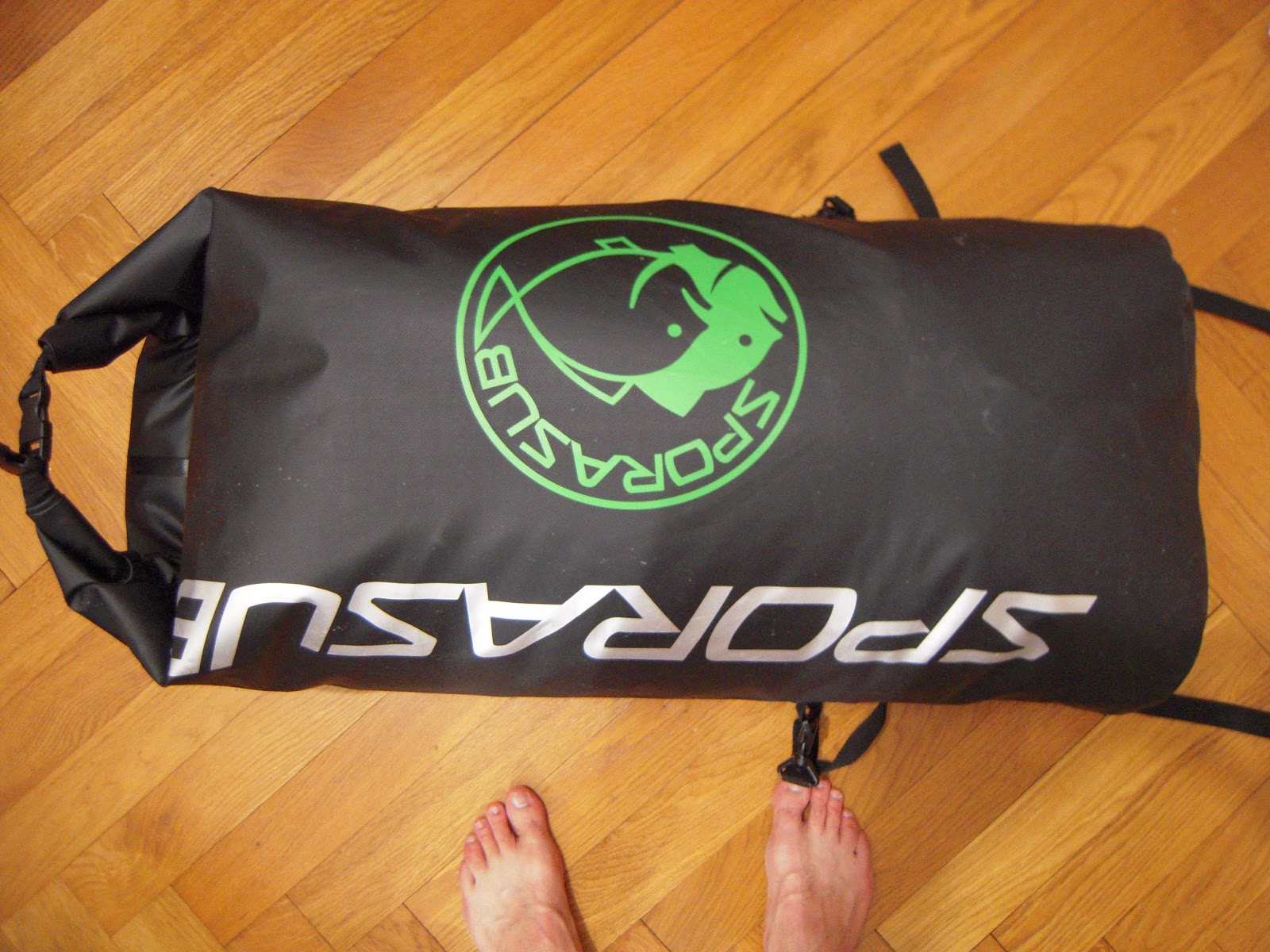
I was looking for a new backpack to put my gear in since my old one broke. I was unable to find one like it (thick netting material, long enough for my fins, that can fold up), the ones currently on the market are not long enough. I need it to fold up because when I shore dive I cannot leave my bag behind so I need to be able to fold it up small and put it on my Best Hunter Okipa II float. I then found that SporaSub makes a dry bag that is a backpack AND long enough for freediving fins (dimensions (h x w x ?) are 109cm x 41cm x 21cm, not sure what the 21cm are though, maybe the top when it is closed?); I figured that I can also fold it up and put on my float, worst case if I need the room for other stuff it can even be tethered to the buoy and float next to it. Salvimar also makes a dry backpack too ("Dry Backpack 60/80"), but the old model was not long enough and the new model virtually has the same name ("Dry Backpack 60" and it shares the exact same model number) so I was afraid that ordering on online websites I would see the old model instead (many had a mix of the old name & new dimensions new name & old dimensions, etc). The Salvimar bag has removable straps that allow you to use it as a duffel bag and it is a bit wider (dimensions (h x w x ?) are 110cm x 44cm x 28cm). I liked the extra width but was afraid the strap attachment area being smaller that it made it more fragile; the SporaSub bag has a much wider attachment area since it is like if you take a padded backpack back and glue it to the dry bag. The Salvimar I think can fold up more since it doesn't have the padding part. I was also not able to find any good reviews on the Salvimar bag and the ones I found were on the old model. For all those reasons I went with the SporaSub bag.


Build

The build is ok, I am not sure how much weight it can take as the bottom looks like it is only glued. I think they should have stitched the seams for strength and then glued it tight:


The fabric is thick however, it is a type of flexible rubbery plastic covered cloth. The straps are ok, the back padding is nice so you don't have anything poking in your back and it also feels better than the plastic material against your bare back as it is made in one of those breathable materials:

The strap and back welding seems good thought, better than on the bottom:


The opening is like all dry bags except it has a male and a female clip on one side and a female clip on the other:


It has chest and  abdomen attachment straps to help secure it so it doesn't sway around and it makes it nicer to carry:


Usage

It works as advertised, I am able to fit my 87cm (total length) freediving fins, my wetsuit, gloves/socks, my float and it's pump, my net, the float line and anchor, my mask and tuba, a sandwich and some water, an insulated bag with an ice pack, a short rock speargun or even a 75cm speargun with the spear (110cm) off of it (the spear sticks out a bit). The straps and back are comfortable, more than expected, I could see myself carrying it a while with no issues, even in the sun.

With all of the stuff described above, including a short cave gun
I had one issue though and I think it is a defect, the abdomen straps have each a male clip:


On the videos I clearly see them having one male and one female clip so you can clip them together. I used it to my advantage though, I added a female clip to one side but kept the male clip:

When I need to fold up the back I just role it up and use the male clips to attach to the female clips on the top to secure it all:


When it is folded up I can still put my t-shirt, swimsuit, water shoes inside (the sandwich I put in another small dry bag) and it is still small (and water tight). I still think the Salvimar bag would have been a bit better to fold up though (and roomier). I am not sure about the build since I have not seen it physically, but if it is stitched and glued then it may have been better than the SporaSub bag, but too late now.

It is ok to carry around as a backpack, not so much as a duffel bag though (my previous bag, like the Salvimar bag also, you could do both). Also I miss having a small pocket in the front and a money pocket inside, but I guess this is not really what a dry-bag is for. I will simply buy a small bag and put it inside.

My previous bag was netted with a bottom drain so the water flows out (so you don't carry it around), it dried quickly (Nylon), while you are walking your gear dries a bit (and the water drips out) but when you had wet things inside, especially a wetsuit, it dripped in the car trunk. This new bag, being a dry bag, it is the opposite, it keeps the trunk dry (but you have to carry around the water so make sure to get as much excess water off your gear), the gear does not dry at all inside and the bag itself needs to be thoroughly dried inside after use.

I no longer carry my weight-belt inside the bag since the bottom looks like it could come undone with the weight, this means that either you need to put it on (I don't like having lead against my skin when I sweat and I always wonder if it can seep inside me) or carry it in your hand (which limits the amount of longer spearguns you can take (you can in reality put them all in the bag, the tips will just poke out), the number of fish you bring back if you carry them outside the backpack, and since you may no longer have any free hands it can limit the type of path you take.

Conclusion

It is not bad a bad product, it does what it was made to do and it is very comfortable to use. I happen to have different needs so I cannot put much blame on the bag. I am disappointed on the glued construction, stitches should be used IMO for a bag especially since glue ages not so well and it usually breaks apart when you are using it... I am not sure if I would recommend this product just yet. I would really like to compare it with the Salvimar Dry Back Pack (60/80, 2015 or 2016 model).

Update

I have used it a couple of times now and it is quite good. The glue has not undone yet, the padded back is nice when you have lots of stuff inside and the shoulder straps are comfortable. I still do not know how well it will age, but only time will tell. I would still like a carry handle on the side to carry it like a duffel bag sometimes.

Sunday, August 23, 2015

Fins

Introduction

Fins are an important part of spearfishing gear, I would say that they are, with the Mask, (Snorkel/Tuba), and the Spearfishing Apparatus, the most important gear. Any other gear you could live without and still spearfish (omitting laws & personal comfort). The fins are what will allow you to move in a fast, safe and fluid manner in the water; they also allow you to dive down in an easy way. Without fins a strong current could take you away, you could not move around under water easily to hunt and to dive down you would need a weight attached to a rope and a boat to allow you to go down fast and bring up the weight after each dive or a bottom anchor and a rope to climb down for each dive. Generally speaking your down time would be horrible and it would be very hard to spearfish like this.

Types of Fins

There are many types of fins:
  • Snorkling
  • SCUBA
  • Freediving/Spearfishing
  • Underwater hockey
  • ...
The most common are the top three, in that order, I will not mention the forth type.

Scuba Fins

Scuba fins are usually open heal to allow booties to be used:

They vary in length and width and may have other gadgets/shapes to them; They are however usually wider to overcome the resistance from all their equipment and rather short to be less cumbersome. The footpocket and the blade are permanently attached together in the fabrication process. The blade is made of some sort of plastic. Power transfer is not optimal with the open heal and they can be painful without booties or socks. This is not an issue for scuba divers as they don't really need to swim optimally, they are too heavy and not streamlined enough for that anyways and they have a large external oxygen reserve so usually they do not worry so much about using the O2 in their blood optimally (I am simplifying things here). These fins are not very good for spearfishing (just as a reminder I exclusively speak of apnea spearfishing in my blog).

Snorkeling Fins

Snorkeling fins are light & flexible closed heel fins:


They vary in length and width and may have other gadgets/shapes to them. They are usually less wide and longer than Scuba fins, they are also softer. The footpocket and the blade are permanently attached together in the fabrication process. The blade is made of some sort of plastic. This type of fin is usually meant to be used without socks but you can use socks if you want. You can use these fins for spearfishing, I have used them for several years (my most recent being the Beuchat X-Voyager; this type of fin is cheap and if you get one with the right blade stiffness and long enough it is OK for shore/hole/reef/rock spearfishing. They may not be optimal but it will allow you to practice and perfect your technique.

Freediving/Spearfishing

These fins are long closed heel fins:


They vary in length but are much longer than the other fin types mentioned above:


The blade can be between 65cm and 85cm in length. The reason they are so long is that the blade's structure is linearly graded (thicker on one end and gradually getting thinner until the other end). This creates a leaver effect which give the fin a ratio between the energy the freediver has to give and the effective energy the fin generates is greater than any other fin type. This means that you use less O2. The footpocket is much stiffer than for other types of fins; this is to maximize power transfer (leg to blade). The footpocket and the blade can either be are permanently attached together in the fabrication process or separate. The separate type can be fixed permanently or modular; modular fins allow you in theory to buy a footpocket that fits you well/that you like and use blades from different brands, different materials, different stiffness, etc:

In practice not all blades fit with all brands, some footpockets have features that means only their blades will fit (Salvimar):

or make it difficult to fit other blades (Beuchat). Omer, SeacSub & Pathos seem to be the most generic. The blade can be made from different materials, I will talk about that later. They are usually meant to be used with socks but you can use them with socks if you want (if they fit and do not hurt your feet).

Freediving fins are however the most expensive types of fins, even the cheapest are more expensive than the expensive snorkeling fins. They are of course the best type for Spearfishing. I will exclusively talk about this type of fin from now on.

Parts

Fines are made up of two main parts, the footpocket:


and the blade:


The footpocket can either be open heel:

which are usually used with booties or socks The other type is closed heel:

Which are used it or without socks (but never booties).

The blade can be made of different materials (see below) and it can have some extra options (see below)

Footpockets

Footpockets can be made of one or several bonded materials; having different materials allows the footpocket to be reinforced in some places and softer in others with the aim of improving the mechanical aspects and comfort. For example the Cressi Gara Modular has a different material on the sides (harder) and in the middle (softer). You need to choose a footpocket that fits you well with socks, you can always use a fin keeper if they are a bit too big without the sock if you with to be able to not use socks at some point. The reason for using socks is more than just for thermal comfort, these types of footpockets are usually harder than snorkeling footpockets and they tend to have "sharp" edges which can cause a lot of pain. You could always trim or round them off a bit I guess if you really do not want socks, I have not tried. The footpockets have the part where your foot goes in, an opening in the front for the toes and to let water drain out, and "tendons", these are the long strips that extend on the front part. These have slots inside, usually in the shape of a 'T' for modular footpockets:


But not always:

The type without 'T' slots have to be glued with the blade. The blade slides in the tendon slots before sliding into the bottom slot of the footpocket:

The tendons come in different lengths and stiffness, this is important as it will directly impact the fin performance. For example a very stiff tendon and a soft fin means that only half the blade flexes correctly. I am not a specialist blade/tendon stiffness coupling so I will not be able to help much there, the best is to ask in specialized forums. Also, if the footpocket is too soft then energy is lost in the stretch, a bit like using a bicycle with suspensions in the city (you loose energy to the suspension). One last aspect, the most important, is the fit. It is hard to know in advance if it will fit correctly without actually trying it in water (with a blade in). First there are narrow footpockets such as:
  • Beuchat
  • Cressi
  • SeacSub
and wide:
  • Pathos
  • Omer
  • Mares
  • etc
The pathos being particular in the fact that you can put on a smaller size (with or without socks) and heat them slowly with a hair drier and they will actually mold to your foot (including the distinctive left/right match). I have never tried this but you can find videos and instructions on the internet. If you cannot find your fit or you want dual use (with or without socks), you can get finkeeps to help:


An often overlooked aspect is the bottom, if you hunt around rocks this part can be useful so make sure it is sturdy enough and has some sort of ribbing to keep you from slipping:

Blade

The blade is the other main component of the fin, it can typically be made with (in order of ascending price):
  • Thermoplastic
  • Fiberglass
  • Carbon fiber
  • Kevlar
It has a narrower end (with or without an angle) that slides into the footpocket. The other end can have different shapes depending on the manufacturer/model:

Thermoplastic Blade

Thermoplastic blades are like tanks: heavy but indestructible; they are also the cheapest type. They have their place, I don't think you should just to carbon because you think it is better (because it isn't necessarily better). While they are heavier, thus adding fatigue to your legs, they are usually still good. They are robust which is important to some people, it depends how you hunt. Thermoplastic blades will outlast other types, they can be scratched, bent, etc, much more than other types. They do have a "usage/bending memory" though, this means that the more they are bent in one way they will retain that angle a little each time.


Fiberglass Blade

Fiberglass (sometimes called fiber composite) blades are lighter and more responsive (they snap back better) than thermoplastic blades. They are also more expensive and more fragile than plastic. They are, with carbon fiber blades (see below) real linear graded blades. Plastic blades often use ribs to give the same effect but composite blades rely on the material itself. They do not have the negative type of memory like plastic blades have but have less of a positive memory than carbon blades.
"Ice" Fiberglass blades

Colored, can have patterns too

Carbon fiber Blade

Carbon fiber blades are lighter and more responsive than fiberglass blades. They are also the most expensive and fragile of blade types. They tend to snap (brittle) in an instant if you over-power them and if you scratch them they can delaminate. These should be exclusively used for boat based (blue water) spearfishing since you have no contact with rocks/coral. This type of spearfishing also fits well with this blade because the blade's full potential can be used. Carbon fiber has an "initial/resting state memory" meaning they will always want to return to their initial (flat) state; this means that it helps the freediver a little each time.


Just remember not to jump in the water from the boat with your fins on because they will probably snap.

In general I would suggest:
  • If you are a beginner, cash strapped, or hunt close to rocks/coral and do not want to be careful with your blades, get thermoplastic.
  • If you do mixed spearfishing (rocks + some blue water) or are careful with your fins, and you are not cash strapped, you can get Fiberglass blades.
  • If you solely do blue water spearfishing and money is no object, get carbon blades.
I do not recommend carbon blades if you do not practice blue water spearfishing. Some people swear by carbon no matter how you spearfish but I think this is wrong; each trade has its tools.

Kevlar Blade

Kevlar is a robust material with amazing tensile strength but it is a material which is quite hard to work with. Because of this, even though I have seen 100% Kevlar blades in the wild, it is mostly used in conjunction to other fibers, usually carbon. This makes it easier to work with and adds durability to carbon blades. It is typically either
  • directly woven (crisscrossed) with carbon, this creates an average blade and is the least interesting combination. These are often called "Carbon/Kevlar Hybrid" blades.
  • used as the core sandwiched in between carbon layers, this adds shear stress resistance to keep them from snapping. The carbon being on the outside layers the carbon fibers themselves do all the actual work. I will call these CKC blades.
  • used to protect a carbon core by sandwiching it in between Kevlar. This is used in an attempt to still have a lightweight and reactive fins but also resist high abrasion or abuse around rocks. This variant is they type that Danny (see comments section) calls "Rock Hoppers". I will call these KCK blades.
Kevlar does degrade quickly if exposed to UV rays so it must be used with a UV resistant resins if you want it to last. It can make it tricky to buy because you have to be sure/trust that the maker used these types of resins. Even if the correct type of resin is used you have to be extra careful to keep it out of sunlight when not in use. CKC blades are probably a good alternative if you want to try to have the performance of carbon but because of your leg strength/way of using them they snap. KCK blades are a good alternative if you want the durability of fiberglass but want better performance. 100% Kevlar blades would be a better alternative than Fiberglass per se but it is almost impossible to find due to being so difficult to work with it and thus the price vs advantage ratio (compared to Fiberglass) is too low to be worth the effort.

Composite Blade Stiffness Comparison

I found a nice comparison of various composite materials used to make blades:

Source: Penetrator Fins

You can read the whole post here. Also of interest is this page and this page. Although they are not specific to fins they give good information on the above composites.

Angle

Fins can have an angle going from 0° (flat) to about 30°. The "standard" for fins that have an angle is 15°-22°. The angle helps you do two things, it offsets the natural angle of your ankle & foot so that your kicks push more water and it makes the freediving negative buoyancy free fall smoother (when you no longer float up and your body glides through the water). If the angle is too high, above 25° I think, you will cut through the water instead of pushing it so you will be less efficient. Here are some examples:


Stiffness

The blade stiffness is an important aspect that must be carefully analysed. The softer a blade is the less tiring it will be to fin with at the surface but the harder it will be to go up to the surface from the bottom. The harder the blade is the more tiring it is to fin long distances on the surface but the easier it is to go back up from the bottom. The standard blade stiffnesses are:
  • Soft
  • Medium
  • Hard
some brands add to this:
  • Very Soft (LD/Long Distance)
If you have very strong legs you can go hard, but most people will use medium as an all around stiffness. Very soft fins are sometimes labeled "LD" for Long Distance by some brands, soft fins are very useful if there is strong current or if you have to fin long distances. It really depends on how and where you spearfish and how strong your legs are; as I said above you can choose medium if you are not sure or if you want something for most situations.

Rails

There are two types of rails:
  • Tendon rails: for the 'T' slot in the tendons (thus at the base of the blade):

  • Water channeling rails: channels the water better on the blade (thus at the end of the blade)
surface and prevents it from "slipping"

Thermoplastic blades either have this built in or not, fiberglass or carbon fiber blades have this as extras. The tendon rail is obligatory if you want modular fins, if not you can glue the blade in the footpocket and tendons. The water channeling rail is very useful to help you achieve optimal finning. Imagine pouring water on a blade without channeling rails, the water will spill off in every direction. Now do the same with the rails on, the water will be channeled in one direction. I am not sure if the channeling rails modify the mechanical properties of the blade much. In theory it should depending on the stiffness of the material used although I have not seen any tests on this. I would think that the gain from having them is largely superior to the loss but then again I have not seen them being used by many makers.

Have a look here at this great discussion on water channeling rails by Dan from the FreeDiveStore.

Technique

The finning technique is very important, some techniques are:
  • Frog kick: imagine a frog swimming; this is used mostly by SCUBA divers in caves or wrecks so they do not kick up sediments
  • Dolphin kick: imagine a dolphin swimming; this is like if you had a mono fin
  • Flutter kick: this is the kick swimmers often use, spearfisherman/freedivers use a variant of this
  • Bicycle kick: imagine how your legs move when you ride a bicycle; this is mostly used by SCUBA divers and should not be used by Freedivers/Spearfishemen!
Spearfishermen/Freedivers using freediving fins use a type of Flutter kick with slow, regular, stiff-legged kicks. If you try to Bicycle kick you will waist a lot of energy and not be very efficient. SCUBA/Snorkeling fins are shorter and stiffer so even with Bicycle kicks you move fin, but not so with Freediving fins!

Conclusion

Fins are indispensable, it is important to match you needs to the fins you buy as the price can climb quickly to $500 and above. As stated above, if cash is an issue then get either thermoplastic or longer snorkeling fins, they will be fine. I have a pair of "longer" snorkeling fins for traveling light or rock fishing in rougher waters and a pair of Breier 760B 'SG' fiberglass fins for everything else.

As always, if you have any questions or remarks, please don't hesitate to leave a comment below!